
The fats are then reassembled into triglycerides and mixed with other lipids and proteins into chylomicrons that can pass into lacteals. To absorb fats from the digestive system.
1

Dll4 Promotes Continuous Lacteal Regeneration In The Adult Small Download Scientific Diagram
3
They travel with lymph to.

Lacteals absorb fats in the form of. Malabsorption refers to impaired nutrient absorption at any point where nutrients are absorbed and maldigestion refers to impaired nutrient digestion within the intestinal lumen or at the brush border. Lymph drainage vessels that line the intestine called lacteals absorb the chylomicrons into lymph fluid. Once absorbed the fats and vitamins make their way through the lymphatic system and are delivered to.
Get an overview of three of the key macromolecules of life proteins fats and carbohydrates and how they get digested and absorbed. Digested fats mingle with bile salts which ferry them to the mucosa where they are coated with lipoproteins and aggregated into small molecules called chylomicrons which are taken into the central lacteals of the villi. Below is a video that shows a portion of the inner surface of the intestinal wall.
Atmospheric nitrogen Choose the correct option. This fluid contains lymph and emulsified fats or free fatty acids. Light is visible part of the electromagnetic radiations.
Absorb and Transport Fats - Special lymphatic capillaries lacteals in villi of small intestine absorb all lipids and fat soluble vitamins from digested food bypasses liver much goes straight to adipose tissues 4. They are instead taken up by these lacteals which have much larger pores relative to the capillary and that allows these chylomicrons to travel within them. These are structures that absorb digested food from the small intestine.
Always seek the advice of a qualified health provider with any questions. Special lymph vessels called lacteals are located in the lining of the digestive system where they are responsible for absorbing fat and fat-soluble vitamins from food. Photosynthetically active radiations or PAR are 400-700 nm.
Micelles form chylomicrons protein-coated fat globules which are transported into lacteals lymph vessels in the villi and released in the bloodstream. Now these tiny gaps are small enough to allow capillaries to absorb proteins and carbohydrates but theyre way too small to absorb chylomicrons and so the chylomicrons choose a different route. The blood capillaries absorb most nutrients but the fats and fat-soluble vitamins are absorbed by the lacteals.
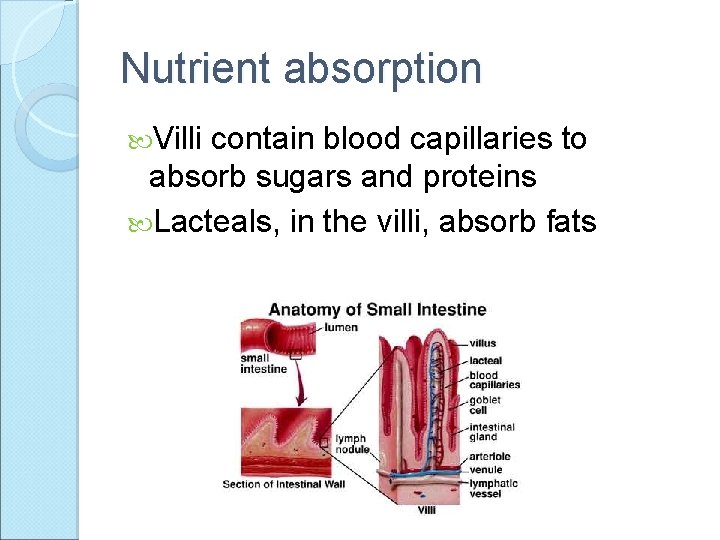
There are blood capillaries and special lymph capillaries called lacteals in the center of each villus. Stomach- water simple sugars and alcohol. Choose the forms in which most plants absorb nitrogen.
There the micelles release their fats to diffuse across the cell membrane. Hemopoiesis - some WBCs lymphocytes monocytes are made in lymphatic tissues not bone marrow main supply of lymphocytes 5. In the villi of the small intestine are lymphatic capillaries called lacteals.
A lymphatic vessel designed to help introduce fats to the blood Lacteals are lymphatic vessels located in the intestinal villi. However specialized lymphatic capillaries called lacteals absorb fats and fat-soluble vitamins vitamins A D E and K. Some amount of absorption takes place in different parts and maximum absorption takes place in the small intestine.
Lacteals absorb fats and fat-soluble vitamins to form a milky white fluid called chyle. The integumentary system protects against many threats such as infection desiccation abrasion chemical assault and radiation damage. Special lymph capillaries called lacteals in the center of each villus absorb the fats from the intestine.
Cushioning of the soles of the feet and palms of the hand Oct 31 2021 What are the functions of triglycerides quizlet. The videos are not intended to be a substitute for professional medical advice diagnosis or treatment. These videos do not provide medical advice and are for informational purposes only.
Blood capillaries are responsible for most nutrient absorption. Nitrates and nitrites 3. It delivers nutrients indirectly when it.
Lacteals are able to absorb fatty acids from the intestinal epithelium and transport them along with lymph. Other absorbed monomers travel from blood capillaries in the villus to the hepatic portal vein and then to the liver. There the micelles release their fats to diffuse across the cell membrane.
Their ability to accept large materials makes them helpful in transporting large fat particles called chylomicrons into the lymph and eventually the bloodstream. The bulk of dietary lipid is neutral fat or triglyceride composed of a glycerol backbone with each carbon linked to a fatty acidFoodstuffs typically also contain phospholipids sterols like cholesterol and many minor lipids including fat-soluble vitamins. A lipoprotein is a biochemical assembly whose primary function is to transport hydrophobic lipid also known as fat molecules in water as in blood plasma or other extracellular fluidsThey consist of a triglyceride and cholesterol center surrounded by a phospholipid outer shell with the hydrophilic portions oriented outward toward the surrounding water and lipophilic portions oriented.
The fats are then reassembled into triglycerides and mixed with other lipids and proteins into chylomicrons that can pass into lacteals. Figure 2365 Histology of the large Intestine. Although malabsorption and maldigestion differ.
Other absorbed monomers travel from blood capillaries. In addition to the microvilli and villi theres a third adaptation in the small intestine wall that helps increase absorption called. As the lymph is collected from the interstitial tissues it also absorbs cellular wastes.
The lymphatic system also facilitates fatty acid absorption from the digestive system. Because fats are hydrophobic unique processes are used to digest and absorb them into the body. The enterocytes absorb water and salts as well as vitamins produced by your intestinal bacteria.
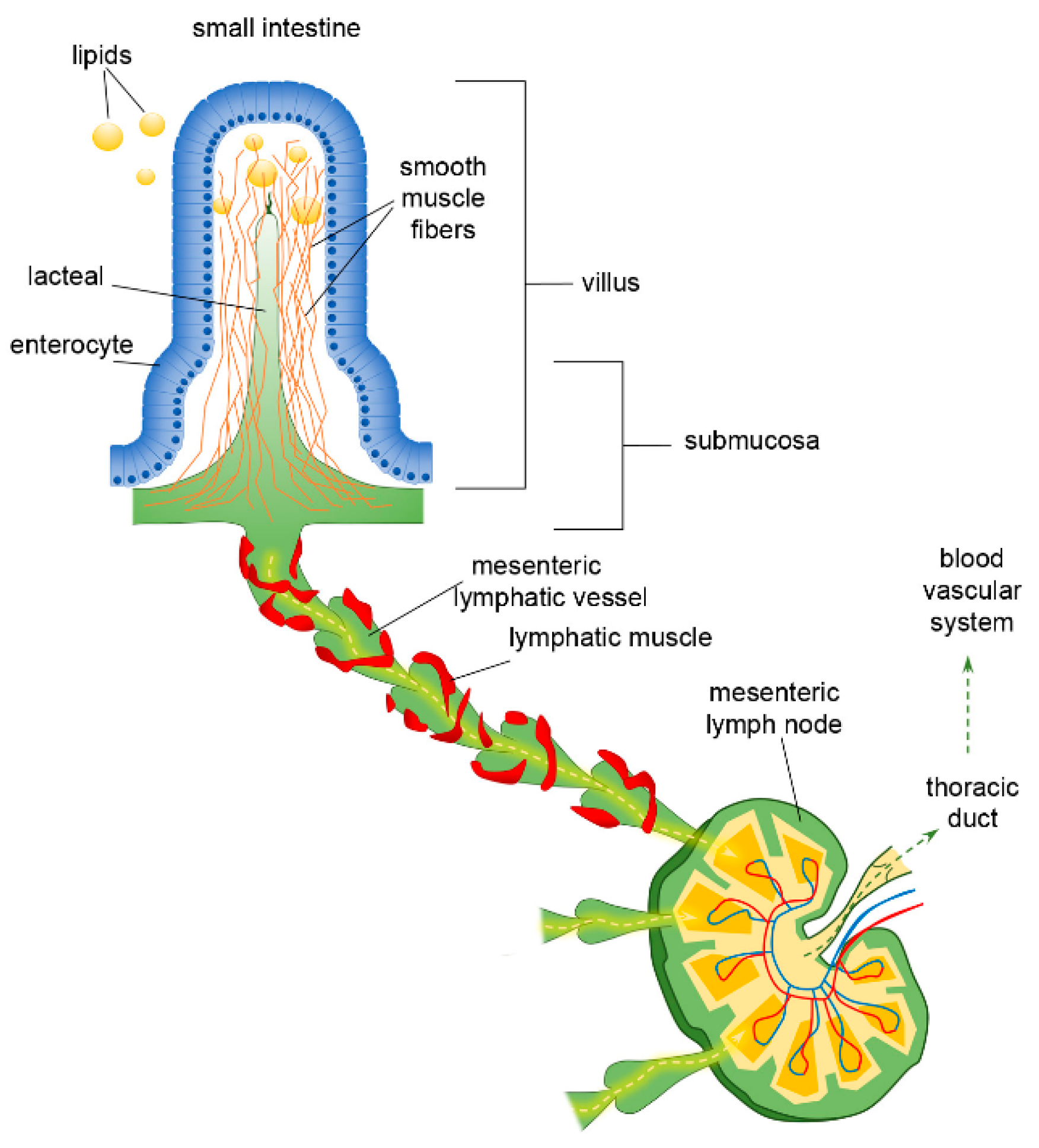
During fat digestion fatty acids are digested emulsified and converted within intestinal cells into a lipoprotein called chylomicrons. The lymph in the lacteals has a milky appearance due to its high fat content and is called chyle. The fats are then transported to the bloodstream and used as.
It has a wavelength of 390-760 nm. Bile salts keep fat from coalescing into large droplets in the lumen of the small intestine. Most of these nutrients are absorbed directly into the bloodstream but most fatty acids the building blocks of fats are absorbed through the lymphatic system.
Each villus is provided with two kinds of vessels. Smaller droplets expose more surface area to the enzyme lipase which is secreted by epithelial cells to break down triglycerides into monoglycerides and fatty acids. Natural source of light is sun but artificial light can also provide energy to plants for their photosynthesis.
Through the lacteals the system takes in fats and some vitamins from the small intestine. Plants absorb light mostly in violet-blue and red parts of visible light. It is covered by very small projections called villi.
The gastrointestinal tract is involved in absorbing nutrients such as fats carbohydrates proteins vitamins minerals and trace elements. Lacteals are lymphatic capillaries that absorb dietary fats. A The histologies of the large intestine and small intestine not shown are adapted for the digestive functions of each organ.

Human Digestive System 1 Describe The Structure Of The Inner Wall Of The Small Intestine And Explain It S Role In Terms Of Increased Surface Area For Ppt Download
Gastrointestinal System Structure And Function Gastrointestinal System Where
The Intestinal Lymphatic System Functions And Metabolic Implications Cellular And Molecular Gastroenterology And Hepatology

Intestinal Lymphatic Vasculature Structure Mechanisms And Functions Nature Reviews Gastroenterology Hepatology

Digestion Absorption And Transport Of Substances Course Hero
Cells Free Full Text Interplay Between Gut Lymphatic Vessels And Microbiota Html

Lipid Absorption Bioninja

Regulation Of Chylomicron Secretion Focus On Post Assembly Mechanisms Sciencedirect


